AI capabilities continue to expand into every corner of business and daily life—from large language models and multimodal generative systems to computer vision, fraud detection, and predictive analytics. As users, we expect richer outputs, higher accuracy, and faster response times. All of this funnels into one ultimate metric: performance. To meet this surging AI demand, hyperscalers are pushing new architectures at the chip, rack, and datacenter levels. With platforms deploying Blackwell‑based / B200 / GB200 instances and 1.6T networking, the industry’s raw computing power is scaling at an unprecedented rate.³
However, as impressive as these new GPUs, optical networks, and memory systems are, they are increasingly constrained by a universal limiter: thermals. Even as performance reaches new heights, the industry is hitting a new wall. With memory temperature now becoming a primary performance constraint, solving it requires more than incremental improvements to traditional cooling technology. It requires a fundamental shift in how we approach thermal management at the package level.
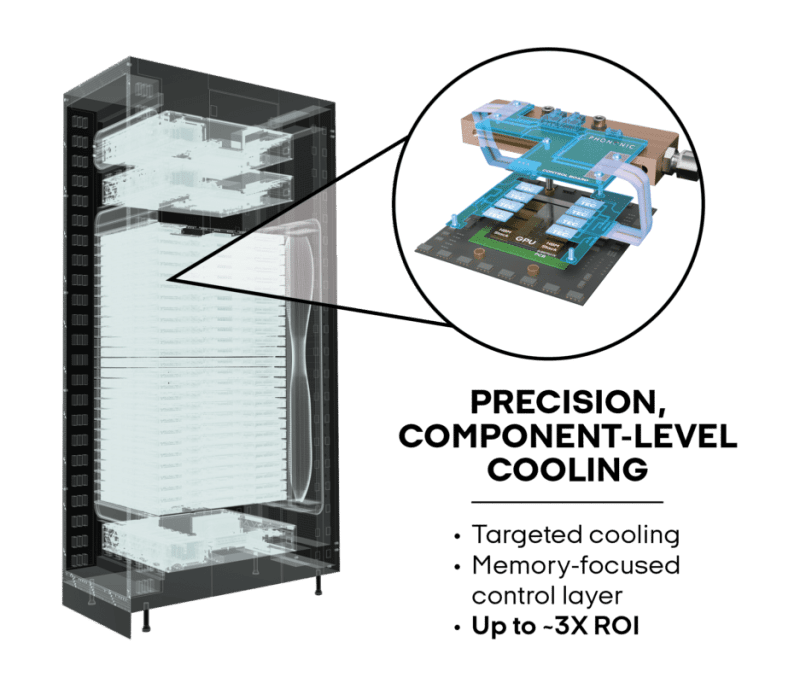
At Phononic we have taken that challenge (and opportunity!) head on. Recognizing the critical importance of providing cooling precisely where it is needed, and just as importantly when it is needed, our Thermal Kits™ integrate TECs (Thermoelectric device) PLUS Firmware PLUS Cart to predictively deliver targeted cooling in milliseconds. Readily integrated into existing liquid or air cooled systems, Phononic’s approach prevents throttling, recovers the performance window and unlocks both compute performance and energy efficiency seamlessly. It’s an approach that converts thermal limits into real-time, system-level optimization made possible across the entire AI data center.
The Physics of AI Memory: Overcoming Thermal Management Limits
The industry has long optimized for compute-heavy workloads, but in modern AI systems, the bottleneck has shifted. We are discovering that memory performance degradation is threshold-driven. Once key temperature limits are crossed, the underlying DRAM changes behavior and effective bandwidth drops. Specifically, high-bandwidth memory (HBM) operates in a tight thermal envelope and typically reaches performance limits before the GPU.⁵
The physics of DRAM are not changing; heat will always impact data integrity. According to JEDEC standards, refresh intervals required to maintain data state must happen more frequently as temperatures rise.¹ Once memory temperatures cross the critical 85°C threshold, these refresh cycles effectively double, stealing cycles away from active computation. Small temperature increases can cause disproportionate performance loss, and small reductions can prevent it. This threshold-driven behavior means that heat is no longer just a secondary infrastructure concern—it is the enemy of sustained performance.
Because AI workloads keep components under constant strain, localized GPU hotspots such as HBM memory, at the tile, package, and interconnect levels can fluctuate in milliseconds. These hotspots trigger thermal protections—like frequency throttling or voltage reduction—that drastically reduce throughput, even if the ambient cooling at the rack level appears sufficient. This creates a unique challenge where high-performance compute optimization is often sabotaged by thermal excursions that occur faster than traditional systems can respond.
Precision AI Infrastructure Cooling: Targeting the Point of Constraint
Traditional AI infrastructure cooling strategies focus on managing average temperatures across the data center (system, node, rack, and facility). Air and liquid cooling are effective at removing bulk heat, but they lack the targeted, millisecond action times needed to keep pace with today’s highly dynamic AI workloads. AI performance isn’t constrained by averages—it’s constrained by the hottest components, often buried deep in the memory layer or within high-speed optical transceivers. Integrating Thermal Kits™ into existing air and liquid infrastructure introduces a new layer of precise thermal control, unlocking the next level of system performance.
The need is real, and the industry is actively searching for solutions. Initiatives like Open Compute Project’s Project Deschutes highlight the push toward new liquid cooling architectures capable of supporting 1MW-class racks. These approaches begin to address component-level cooling—but often at a significant cost. By combining existing liquid cooling infrastructure with the Phononic Thermal Kit™, it becomes possible to balance precise, device-level thermal control with the economics of system and facility deployment, ensuring every watt of energy is directed toward maximizing platform performance.
When components overheat, built‑in protection mechanisms slow everything down to prevent damage. This is made even more complex by chiplet architectures and heterogeneous workloads. To fully unleash next‑generation compute, the cooling solution must be an integral part of the system design—targeting hotspots, adapting dynamically to workloads, and ensuring that every watt of performance is realized.
A New Cooling Solution: Moving to a Solid State Thermal Fabric™
Cooling can no longer be treated as static infrastructure, rather we need to think of it as a new dynamic control plane that can be used to maximize the utilization and output at the Datacenter level – a Thermal Fabric™. This is where solid state cooling becomes the missing link. Advanced semiconductor materials designed for high heat flux removal allow for a fundamentally new cooling paradigm—one that responds as quickly as AI workloads themselves.
Phononic’s approach utilizes a Thermal Kits™ (TEC (Thermoelectric device)+Firmware+Cart) to provide precision thermal control exactly where it’s needed most. These solid state devices act as heat pumps at the node level, allowing designers to:
- Target specific hotspots directly at the tile and package level.
- Activate in milliseconds through telemetry, matching the speed of AI workload spikes.
- Complement existing liquid and air cooling systems, acting as the “fine-tuning” layer for bulk infrastructure.
- Prevent throttling during peak workloads, recovering the performance window that traditional methods lose.
- When deployed throughout the data center, in CPO, GPU HBMs, even at the transceiver level, a previously impossible level of orchestration, utilization and compute performance is unleashed through the Thermal Fabric™.
This “Thermal Fabric™” approach integrates sensing, control, and actuation to manage heat at the point of constraint. It represents the move from overcooling entire systems to regulating temperature exactly where it matters, preserving bandwidth and maintaining consistent performance. These are not theoretical concepts; they are already being deployed under real workloads in demanding networking and compute environments.
Maximizing Data Center ROI Through Advanced Cooling Technology
Cooling has always been a means to an end— accommodating inefficiency to enable hardware to reach peak output. In today’s AI systems, though, the challenge is exponentially more complex: performance and efficiency are now tightly coupled to thermal control. When those limits are exceeded, it’s not just heat, you lose compute utilization, extend training cycles, and reduce throughput. As NVIDIA CEO Jensen Huang noted at CES 2024, the industry is moving toward “cooling with hot water,” with liquid temperatures nearing 45°C. That shift creates a clear opportunity: treat cooling as a performance lever, not just infrastructure, to unlock more from every AI system.
By embracing targeted, precision cooling, a new level of energy efficiency and TCO is readily achievable. Overbuilding infrastructure cooling leads to diminishing returns and excessive power consumption. By contrast, right-sizing cooling at the component level improves utilization while reducing system-level overhead. This approach allows operators to decouple component temperature from facility water temperature, enabling these 45°C loops.
The economic shift is clear: 3rd party analysis in partnership with Phononic’s engineering shows that precision approaches deliver up to a 3× ROI in certain deployments.⁴ When you factor in the performance gains, improved uptime, and the reduction in wasted energy (with PUE improvements between 0.05 and 0.18), the combination is unbeatable.⁴ Operators can now cut their overall cooling costs while maintaining peak processing performance.
Conclusion: Thermally Sustained Performance
AI advancement depends not just on faster chips or better networks—but on cooling innovations that enable them to operate at their full potential. The next leap in AI performance won’t come from silicon alone. It will come from unlocking every degree of thermal headroom to unleash every watt.
The Phononic Thermal Kit™ is the realization of this future—a turnkey solution of hardware and software designed to cool where and when it is needed most. By targeting the thermal hotspots that limit modern hardware, we are empowering the industry to move past the memory bottleneck.
Because in AI systems, performance is no longer just something you compute. It is thermally sustained.
Sources and References
- JEDEC Solid State Technology Association: Standard JESD209-5B, Low Power Double Data Rate 5 (LPDDR5) (Reflecting DRAM refresh thresholds).
- Open Compute Project (OCP): Project Deschutes: Advanced Liquid Cooling for AI/HPC Data Centers.
- NVIDIA GTC/CES 2024: Keynote announcements regarding the Blackwell B300 Architecture, NVL72 Rack Solutions, and 45°C “Hot Water” Liquid Cooling.
- Phononic Internal Engineering Report: The Economic Impact of Thermoelectric Cooling in High-Density AI Racks (2024).
- IEEE Xplore: Thermal Management of High-Bandwidth Memory (HBM) in Heterogeneous Integration.