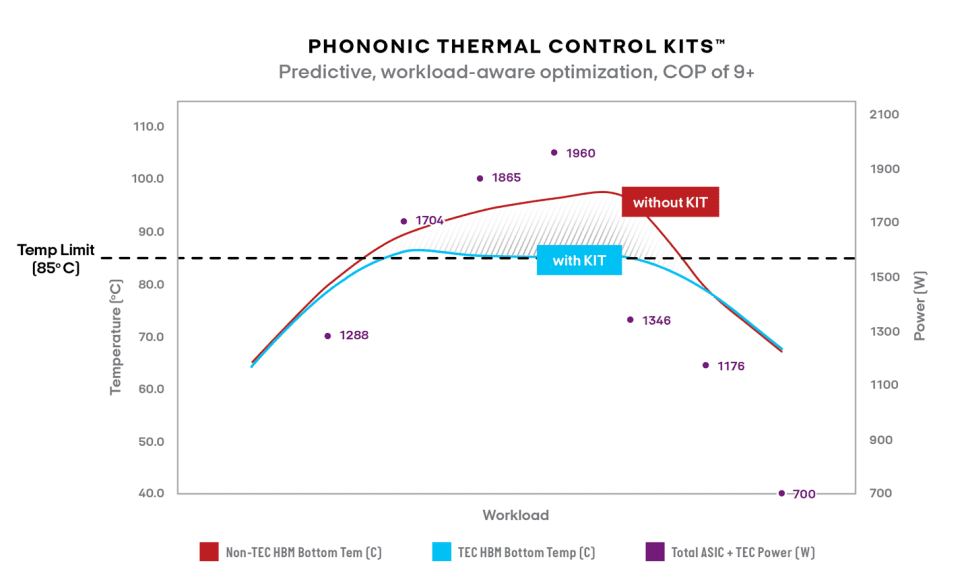
By leveraging intelligent, closed-loop control architecture, the Thermal Control Kit moves beyond precision cooling to provide predictive, workload-aware optimization
Originally Published for AI Week in Data Center Dynamics
AI has fundamentally transformed the data center into a high-density, high-variability compute platform, where thermal behavior is dynamic, workload-driven, and no longer manageable through traditional static design margins.
While effective at bulk heat removal, traditional air and liquid cooling lacks the responsiveness and spatial granularity required to manage localized hotspots and rapid thermal fluctuations inherent to AI workloads. As a result, operators are forced to use traditional approaches – overprovision cooling capacity, throttle performance, or accept accelerated asset failure rates.
To be clear, what is at stake is mission critical. Thermal challenges exist across the AI datacenter, but they are particularly critical for High Bandwidth Memory (HBM). When HBM devices overheat, elevated junction temperatures accelerate leakage and reduce DRAM retention time, increasing the risk of data corruption. As a result, the devices can enter thermal protection modes, degrading performance and significantly shortening silicon lifespan. The challenge is significant and the cost unsustainable.
Introducing the Dynamic Thermal Control Layer – Precision Solid State Cooling Where and When it is Needed
Phononic’s approach combines modular, rapidly deployable hardware that includes solid state thermoelectric (TEC) cooling and Redfish compatible control software to deliver dynamic thermal control exactly where it is needed. Rather than treating cooling as a static facility function, Thermal Control Kits™ enable dynamic, workload-aware thermal control directly into the AI stack. When deployed throughout the data center, the Thermal Control Kits™ form the underpinning of the Thermal Fabric™, a data center-wide predictive thermal optimization and refined workload placement layer.
Unlike conventional approaches that maintain a fixed thermal envelope, Thermal Control Kits™:
Deliver millisecond control of cooling, responding in real time to workload behavior: Actively track and respond to workload-driven power fluctuations, mitigating transient hotspots before they trigger throttling or performance degradation
Apply precision cooling exactly where it is needed, when it is needed: Target high-intensity regions—GPUs, HBM, optics, and power delivery—eliminating inefficiencies associated with bulk or package-level cooling
Allow for real-time thermal telemetry and analytics, unlocking truly workload-aware orchestration: Provides continuous thermal visibility and integrates with orchestration frameworks to enable workload-aware cooling optimization aligned with scheduling, utilization, and performance objectives
This architecture transforms thermal management from a passive constraint into a dynamic, software-defined control plane—capable of balancing performance, efficiency, and hardware longevity in response to real-time AI workload demands.
Phononic’s Thermal Control Kits™ for GPU HBMs: Unlocking Performance
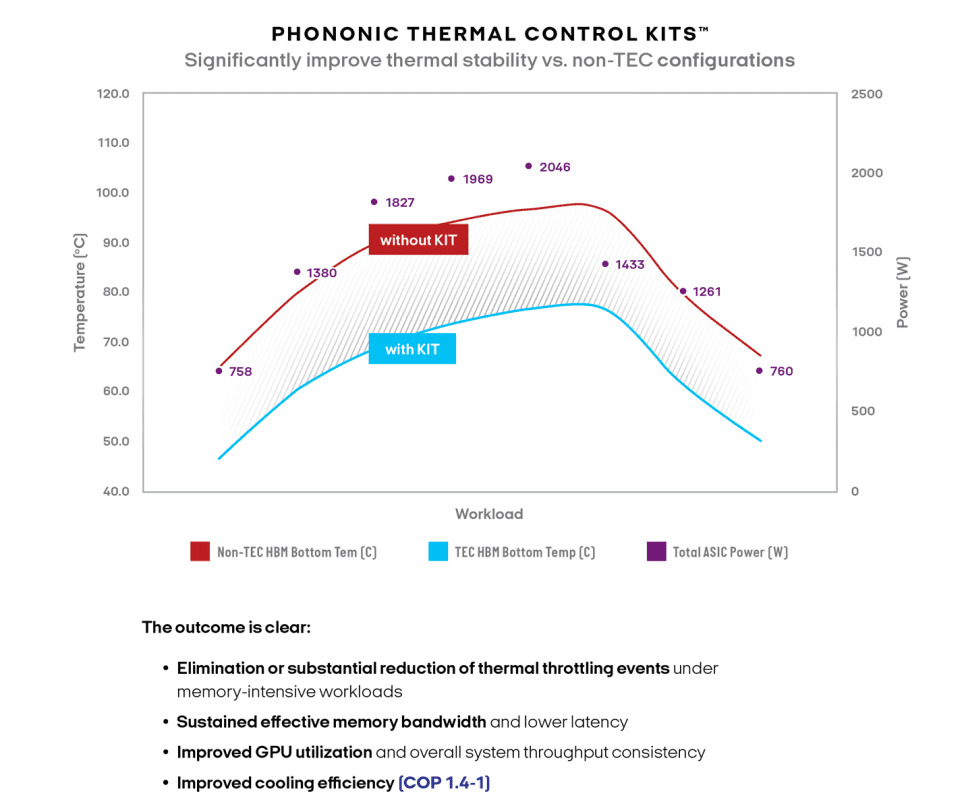
Systems equipped with Phononic Thermal Control Kits™ demonstrate significantly improved thermal stability compared to non-TEC configurations. By actively managing transient temperature excursions at the source, Thermal Control Kits™ maintain HBM operation within optimal thermal bounds—preventing entry into temperature regimes that trigger refresh overhead increases or hard throttling.
Phononic’s Thermal Control Kits™ can provide highly stable temperature control in static operating modes. As shown below, the most basic implementation is to establish a fixed temperature offset (ΔT), with the control package maintaining that differential across the workload to keep the device below the 85°C thermal ceiling.
For this evaluation, the test profile was defined as High GPU + Maximum HBM utilization with an inlet water temperature of 35°C, executed over a 20-minute test interval to represent a sustained, thermally demanding workload.
While the static implementation provides a meaningful improvement in thermal performance, activating the embedded two-way telemetry, software, and firmware control layers within the Phononic Thermal Control Kit™ delivers substantially greater gains. Using the same test profile—High GPU + Maximum HBM utilization, a 35°C inlet water temperature, and a 20-minute sustained workload interval—implementing dynamic control continuously monitors and adjusts cooling performance in real time. Rather than maintaining a fixed thermal offset (ΔT), the system adapts to changing workload conditions, applying cooling capacity only when and where it is needed.
By leveraging this intelligent, closed-loop control architecture, the Thermal Control Kit™ moves beyond precision cooling to provide predictive, workload-aware optimization. This enables a more sophisticated approach to thermal management—one that not only suppresses temperature excursions as they emerge but anticipates and mitigates them before they impact system performance.
This intelligent control layer unlocks an additional dimension of value:
- Proactive throttling avoidance: Cooling is dynamically modulated ahead of thermal thresholds, maintaining both HBM and GPU operation within their optimal performance envelopes.
- Energy-proportional cooling: TEC power is applied precisely when and where required, eliminating unnecessary energy consumption during periods of lower thermal demand and improving overall system efficiency, with a measured COP ranging from 1.9:1 to 9.6:1.
- Continuous optimization across performance and efficiency: Real-time telemetry and analytics enable fine-grained balancing of compute throughput, thermal headroom, and power consumption.
The result is a fully adaptive thermal system that aligns cooling behavior directly with AI workload dynamics, maximizing performance while minimizing energy consumption.