Delivering Advanced Cooling Solutions for Pioneers like CERN Pushing the Limits of Science
Delivering Advanced Cooling Solutions for Pioneers like CERN Pushing the Limits of Science
The Power of Phononic’s Differentiated Design
CERN is one of the world’s largest and most respected centers for scientific research in particle physics. Located near Geneva, Switzerland, it was founded in 1954 and is known for pioneering work in understanding the fundamental structure of the universe. The instruments used at CERN are purpose-built, industry-leading particle accelerators and detectors designed to be leading-edge, singularly advanced scientific equipment. Accelerators boost beams of particles to high energies before the beams are made to collide with each other or with stationary targets. Detectors observe and record the results of these collisions.
One such detector is the Compact Muon Solenoid (CMS). The CMS detector is built around a huge solenoid magnet. This takes the form of a cylindrical coil of superconducting cable that generates a field of 4 tesla, about 100,000 times the magnetic field of the Earth. The field is confined by a steel “yoke” that forms the bulk of the detector’s 14,000-tonne weight. An unusual feature of the CMS detector is that instead of being built in-situ like the other giant detectors of the LHC experiments, it was constructed in 15 sections at ground level before being lowered into an underground cavern near Cessy in France and reassembled. The complete detector is 21 meters long, 15 meters wide and 15 meters high. The CMS experiment is one of the largest international scientific collaborations in history, involving about 5500 particle physicists, engineers, technicians, students, and support staff from 241 institutes in 54 countries (May 2022). The CMS experiment is advancing our knowledge of the universe through some of the most intense and rigorous experimental methodologies.
Harsh radiation environments require a novel approach to preserve gain and photon detection efficiency
The CMS detector has plans for a major upgrade, scheduled to be completed in 2026, during their pre-scheduled 3-month winter shutdown period. The upgrade is intended to allow the detector to maintain its event reconstruction capabilities during the High Luminosity phase of the Large Hadron Collider (HL-LHC), addressing the major challenges of an estimated ten times higher integrated luminosity and radiation levels. The MIP Timing Detector (MTD) is a novel sub-detector, which will be inserted between the silicon tracker and the electromagnetic calorimeter, designed to tag the time of arrival of charged particles with a time resolution in the range of 30 − 60 ps. The barrel section of the MTD, the Barrel Timing Layer (BTL), is based on LYSO:Ce crystals arranged in arrays of 16 units, readout by packaged arrays of Silicon Photomultipliers (SiPM). Based on estimates by the CERN team, the crystals and SiPMs will be exposed throughout the entire operation to harsh radiation environments never used in any other large area experiment. Unfortunately, the effects of radiation on SiPMs have been studied extensively, and Silicon Photomultipliers exposed to this level of radiation have shown a strong increase of dark count rate and radiation damage effects that also impact their gain and photon detection efficiency. This challenge prompted the CERN team to engage our team at Phononic to design and integrate small thermo-electric coolers (TECs) on the back of the SiPM package to decrease the operating temperature, with the intent to reduce dark count rate without requiring additional power.
The Phononic Contribution
Integrating TECs into SiPM packages to enable searches for long-lived particles
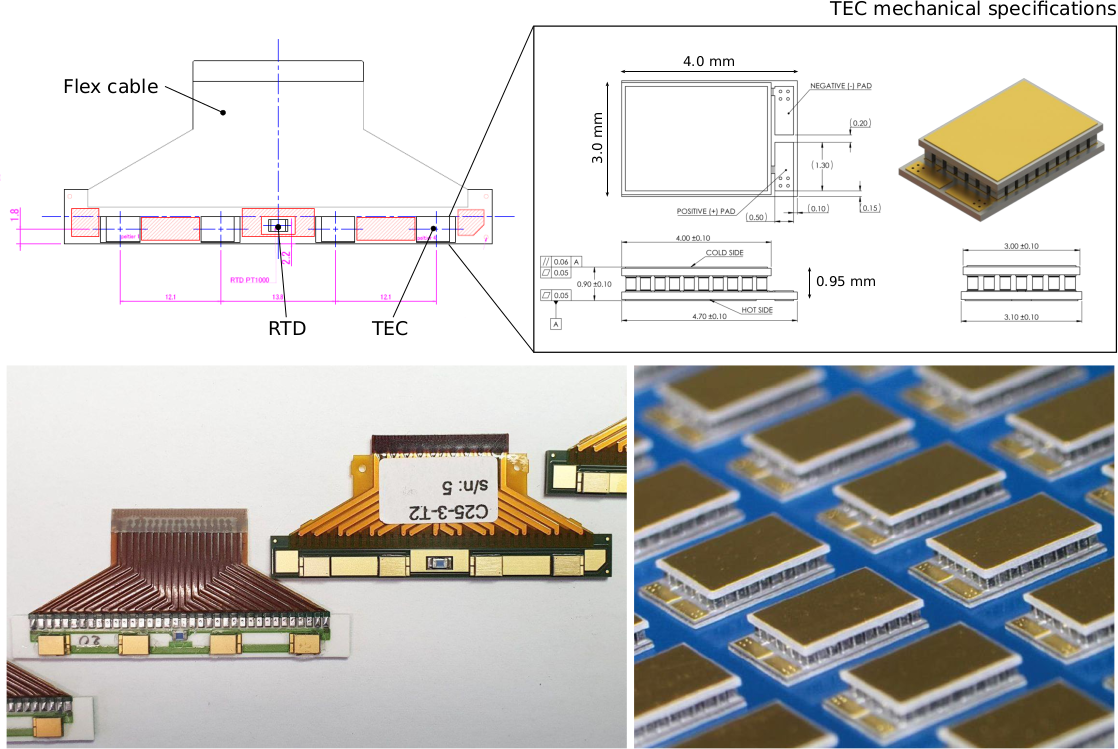
The CERN team engaged the Phononic team to design and model the predicted cooling effects and response time of Phononic’s TECs. The effort began with a deep discussion on the requirements and constraints from the CERN team, which the Phononic team of experts immediately converted to a clear and credible proof of concept, building from a wealth of existing off-the-shelf TEC designs and protocols. After a successful proof of concept with feedback and alignment, the CERN team engaged Phononic to design and produce more than 5,000 customized TECs [Figure 6], which were mounted on dedicated PCBs for initial testing, while others were mounted on BTL SiPM arrays from two different SiPM manufacturers. Successful testing and real-world results on par with Phononic’s modeled expectations led CERN to order TECs produced in Phononic’s high volume capacity facility. All delivered in a few months and on schedule for the CERN team
Simulation of the temperature inside a BTL detector module obtained using ANSYS (side view, see figure 2 for description of the components). The left plot shows the temperature map inside a module during operation with a cold plate at −35◦ C and SiPMs at −45◦ C, the right plot shows the temperature map during annealing periods, i.e. with the cold plate at 10◦ C and the SiPMs at 60◦ C.
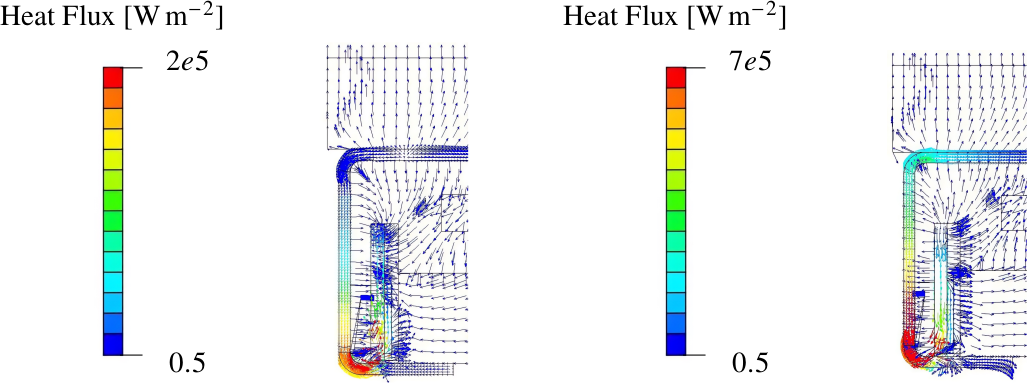
Simulation of the heat flow inside a BTL detector module obtained using ANSYS (side view, see figure 2 for description of the components). The left plot shows the vector heat flow inside a module during operation with a cold plate at −35◦ C and SiPMs at −45◦ C, the right plot shows the vector heat flow during annealing periods, i.e. with the cold plate at 10◦ C and the SiPMs at 60◦ C.
The experimental results from the CERN team revealed that Phononic TECs, even under these unprecedented challenging conditions, provide additional 14 cooling to reduce the SiPM operating temperature from -35°C to -45°C without requiring additional power budget for the detector module. This results in a beneficial reduction of the dark count rate during operation by a factor of about two. To counteract SiPM radiation degradation, TECs have been proven capable to also heat the SiPM operating temperature up to about 60°C in order to thermal anneal the radiation damage effects resulting in recovery of the depredated dark count of the irradiated SiPMs. Another benefit of using the TECs directly for thermal annealing prevents the need for additional hardware as well as costly rebuilding and/or replacement during maintenance, Following the positive results of dedicated radiation tolerance and longevity tests performed on the TECs, the integration of such devices on the SiPM package has been adopted as the baseline for the BTL detector. Ultimately, the capability unlocked for CERN with the Phononic TECs will provide powerful information to help disentangle the overlapping trajectories of charged tracks and mitigate the effects of pile-up on the reconstruction of physics events. This additional time-of-flight information will also enable new searches for long-lived particles and extend the domain of particle identification in the Heavy Ion program.
Top: technical drawing of the back side of a BTL SiPM array where the location of the temperature sensor (RTD) and of the four TECs is visible, including dimensions of the thermo-electric coolers. Reproduced with permission from Phononic. Bottom: picture of BTL SiPM arrays (back side) from different manufacturers with TECs and RTDs (left) and picture of a batch of TECs as received from the supplier.
Our Application-Specific Design Process: A Win for CERN and Phononic
Phononic's unparalleled design delivers cooling under tremendously challenging conditions
CERN operates under some of the most demanding operating conditions imaginable, and when their team needed a TEC capable of consistently delivering cooling under these unprecedented conditions, they engaged the unparalleled design capabilities and real-world modeling of the Phononic team. Developed in a truly collaborative approach, the Phononic team grounds themselves in the specific performance and form-factor requirements, working with customers to disaggregate must-haves from lesser requirements, surfacing incremental design flexibilities and creative designs. Delivering first proofs in weeks, with short timelines to transition to full global supply and delivery of highest quality TECs. Quality characterized by millions of deployed TECs globally. Meeting the cooling demands of partners pushing the boundaries like CERN and deployed across all major US hyperscaler data centers to propel the world forward to meet the expanding demands of AI.
TEC Design with Phononic
Phononic’s state-of-the-art thermoelectric coolers are quickly becoming the fiber-optic industry’s go-to TECs, with good reason. In the past five years, Phononic has deployed more than 35M TECs into the field with unprecedented results. Phononic TECs can currently be found in every major hyperscaler, as AI data centers work to meet today’s skyrocketing data demands.
Phononic’s industry-leading engineering team has decades of experience and prioritizes quality of design at every stage of development to ensure our TECs enable the technology that supports the demands of high- speed data centers and other critical applications.